 By Lewis Ashcroft
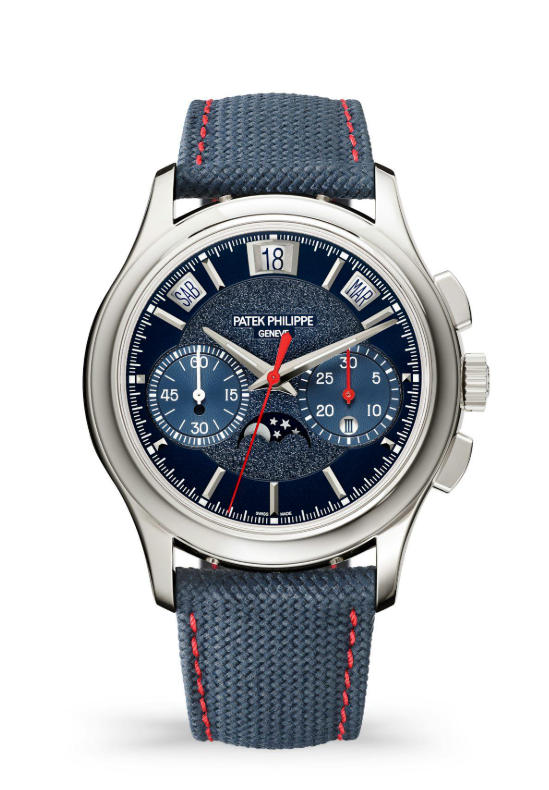
Patek Philippe has refined its perpetual calendar chronographs for decades, making a fresh interpretation of this complication far more significant than a simple model update. Ref. 5978P exemplifies this. Created specifically for the 2026 Milan Watchmaking Art Exhibition, this timepiece is not simply a redesign of an existing watch’s color or a familiar movement housed in a different case. Its proportions, date display, and movement structure have all been redesigned, giving the watch a unique style distinct from traditional perpetual calendar chronographs. This distinction is crucial because Patek Philippe’s reputation in this field is built on heritage. Models such as the 1518, 2499, 3970, 5970, and 5270 have evolved progressively, each generation subtly altering details while maintaining a clear connection between the chronograph and perpetual calendar. The 5978P belongs to this heritage, but it doesn’t strive to repeat its visual language. The larger platinum case, triple date window, blue dial, and composite strap give the watch a more modern feel, while the new CH 29-535 PS QI movement provides mechanical support for these changes.
For readers who follow our coverage of British replica watches , these timepieces deserve special attention, as almost every important design decision is closely related to the internal mechanical structure. Replicating the overall concept of a blue Patek Philippe watch with complications is not difficult, but perfectly replicating the harmony between the case thickness, date window, chronograph subdials, moon phase display, and movement structure without it appearing jarring is far more challenging.
The 5978P watch showcases a modern aesthetic while retaining Patek Philippe’s unique charm.
What’s surprising first is its size. The 5978P has a 42mm diameter and a 14.24mm thickness, making it larger and more imposing than many would expect from a Patek Philippe perpetual calendar chronograph. On paper, these dimensions might seem like an enlargement simply to cater to modern aesthetics, but considering the dial as a whole reveals the rationality of the case size.
Perpetual calendar chronographs need to convey a lot of information. Trying to cram all that information into a small dial inevitably creates a visually overwhelming effect. Early models addressed this with traditional sub-dials and carefully designed typographic layouts, but ultimately, the wearer still needed time to read the time. The larger dial of the 5978P provides more space for the calendar window and chronograph indicators, allowing the information to be clearly presented rather than compressed. The platinum case doesn’t feel bulky as its size might suggest. The concave bezel reduces the visual burden around the dial, while the curved lugs soften the transition between the case and the wrist. The fully polished case surface gives the watch a cleaner, more modern look than many older complicated timepieces. A brilliant-cut diamond at 6 o’clock highlights the platinum material; this subtle detail doesn’t detract from the overall design.
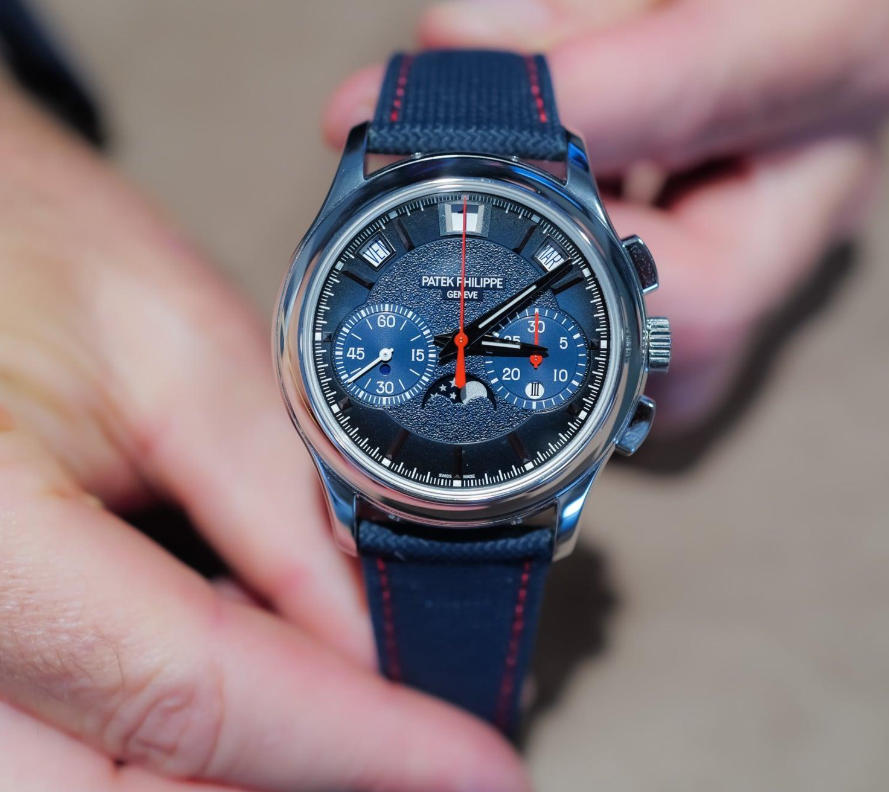
The strap further alters the watch’s style. Instead of the polished leather strap commonly found on perpetual calendar chronographs, Patek Philippe opted for a deep blue composite strap with a fabric texture. Red stitching and a small Italian-style detail echo the Milan Expo without making the watch feel like a deliberate commemorative piece. It’s difficult to describe this watch using the traditional distinction between sports and dress watches. The 42mm platinum Patek Philippe 5978P remains an extremely complex precious metal timepiece, yet it feels more relaxed and casual than those that pioneered the perpetual calendar complication. This may be a deliberate move by Patek Philippe. They didn’t try to make the perpetual calendar chronograph a sports watch, but rather freed this complication from the constraints of traditional dress watches.
The dial itself is highly designed. The navy blue dial is already quite unique for this series, but its treatment goes far beyond a simple color change. The outer edge of the dial features a sunburst effect, with the color gradually deepening at the edges, while the central area is textured. These subtle variations give the dial a rich sense of depth without relying on decorative engravings or intricate patterns.
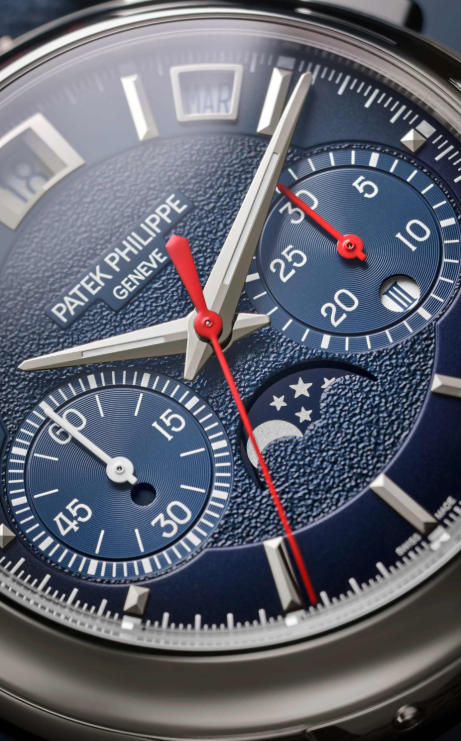
The upper half of the dial features three framed windows displaying the day of the week, date, and month. These indicators are all in Italian, directly indicating the watch’s close connection to Milan, but more importantly, they transform how the watch is read. The calendar no longer requires the wearer to decipher multiple tiny hands; instead, it’s presented directly in a single horizontal arrangement. This makes the dial appear far simpler than its number of complications suggests. The calendar information occupies a clear area on the dial, while the chronograph and running seconds hands are located below, and the moon phase display is at 6 o’clock. The leap year and day/night indicators, though small, are not overpowering. This separation is one of the highlights of the design. Complicated watches often sacrifice everyday readability for visual impact. The 5978P does the opposite. It contains far more mechanical information than most watches actually require, yet its basic calendar function is clear and easy to understand.
The white gold hour markers and dauphine hands retain Patek Philippe’s classic style, while the luminescent coating gives this watch a more casual feel than previous perpetual calendar chronographs. The red chronograph hands contrast sharply with the dial, clearly displaying the chronograph function without making the dial appear too sporty.Therefore, the instantaneous perpetual calendar display of the Patek Philippe 5978P is not merely a stylistic experiment. Its visual simplicity stems from the meticulous design of its internal mechanical structure, which revolves around the way information changes. This close connection between appearance and mechanics is one of the main reasons why this watch feels seamless rather than just novel.
The new movement explains why Patek Philippe changed the dial.
The CH 29-535 PS QI movement is the heart of the 5978P and the strongest argument for viewing this watch as a new chapter rather than just another variant. It is manually wound, comprises 500 parts, and seamlessly blends a traditional chronograph structure with an instantaneous perpetual calendar function. Operating at 4 Hz, this movement offers approximately 55 to 65 hours of power reserve with the chronograph function off. While these figures are useful, they don’t explain the movement’s uniqueness. The key lies in how the energy is effectively managed when different indications need to be switched.
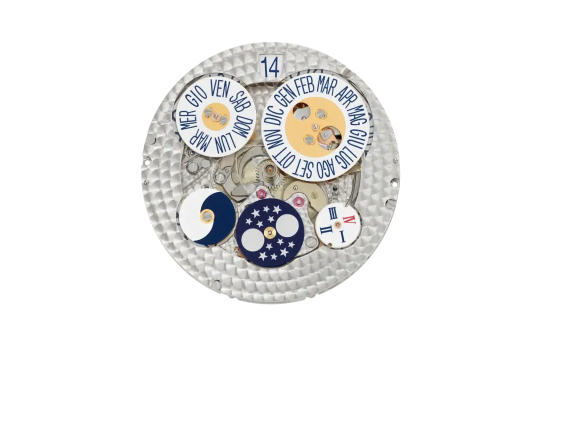
Perpetual calendars need to track months of varying lengths and leap years, while also coordinating multiple displays around midnight. In traditional designs, some displays might begin changing before midnight and end after midnight. Patek Philippe, however, takes a more direct approach. The calendar display is designed to quickly synchronize changes, providing the wearer with a smoother daily transition experience.
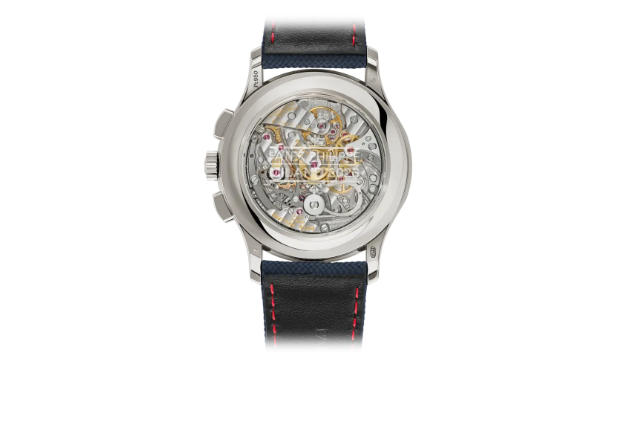
The design philosophy of the chronograph is similar. Its 30-minute counter advances instantaneously, rather than moving slowly between minute positions like other chronographs. This may seem like a minor visual detail, but from a mechanical perspective, it requires the movement to store and release energy at the right time. The allure of the 5978P extends far beyond what’s presented on the dial. Its date window is not simply a redesigned graphic layout on top of the existing mechanical structure. The CH 29 535 PS QI manual-winding movement is designed around the operation of the dial. Compared to watches that merely place the same movement under a redesigned dial, the 5978P has a much closer connection between form and function. The sapphire crystal case back showcases this connection perfectly. The movement occupies most of the case back, allowing the wearer a clear view of its structure and fine finishing. The “Milano 2026” inscription on the case back indicates that this watch is one of the 120 limited edition pieces, but the movement itself is the highlight that deserves more careful appreciation.
This is precisely the biggest challenge any future replica watch will face. Replicating the front of a complicated watch is already difficult, and a transparent case back further reduces the room for compromise. Even if a replacement movement can function as a chronograph and calendar, its bridge shape, gear positions, balance wheel position, and finishing may differ significantly from the original. The movement structure also affects the watch’s appearance. If the replacement movement is thicker, the case may also need to be thicker accordingly. If the calendar function is different, the position of the calendar window or sub-dials may need slight adjustments. These differences may seem insignificant individually, but complicated watches are extremely sensitive to proportions. Once multiple details are changed simultaneously, the overall appearance will deviate from the original. Therefore, the 5978P perfectly illustrates the limitations of judging a replica watch solely by photographs. A front photograph can tell us some information about colors and layout, but it cannot confirm how the calendar changes, the case thickness, the movement’s construction, or whether the watch’s performance is the same as the genuine article.
The hardest thing to copy is not the logo.
The replica watch market still heavily relies on broad descriptions like “high-end,” “super replica,” or “1:1.” While these descriptions may sound reassuring, watches like the 5978P demonstrate that they are not entirely accurate without close inspection. The case is the first thing to consider. Achieving a 42mm diameter isn’t difficult, but replicating the bezel curvature, lug shape, case thickness, and overall wrist comfort is much more challenging. A replica watch that’s even a millimeter or two thicker will feel noticeably heavier and more unbalanced, especially when the original is carefully designed to control visual size. Material is another crucial factor that photographs cannot fully explain. Platinum gives the genuine watch a distinctive weight. A stainless steel case can be polished to resemble images, but it won’t feel the same in the hand or on the wrist. Surface color may also differ slightly under natural light.
The dial is even less forgiving. The three calendar apertures form a strong visual line across the upper half of the watch. Their height, spacing and width have to work with the surrounding markers. If one aperture is too large or the typography is too heavy, the entire dial begins to feel unbalanced.The Italian day and month indications add another level of detail. Typeface, alignment and the amount of white space inside each window are easy to overlook, yet these are exactly the areas that become noticeable once the watch is viewed closely.The colour and finish of the dial deserve the same attention. The genuine 5978P combines several treatments rather than relying on a flat blue surface. Under different lighting, the dial can shift from bright navy to a much darker tone near the edge. A simpler replica dial may match the colour in one controlled photograph but lose that depth when seen in daylight.The moon phase is another detail worth watching. On a complicated Patek Philippe, the moon disc is part of the balance of the entire lower half of the dial. Incorrect colour, scale or positioning can make the watch look wrong even when most of the other indications are reasonably accurate.
The movement remains the clearest dividing line. A replica Patek Philippe 5978P perpetual calendar watch may eventually offer working calendar indications, but functional similarity should not be confused with mechanical similarity. A movement can show the same information while being constructed in an entirely different way.That distinction matters more here because the back is transparent. The owner is not only looking at whether the movement runs. The position of the balance, bridge layout, decoration and overall depth are visible parts of the watch.
Readers comparing this model with other complex pieces can browse our Patek Philippe replica articles , where references such as the Nautilus, Aquanaut, Cubitus, and other complications present very different challenges. A simple sports model may depend heavily on bracelet finishing and case shape. The 5978P adds calendar mechanics and movement architecture to that list. The genuine watch is limited to 120 pieces and was created specifically for the 2026 Milan Watch Art exhibition. Patek Philippe lists the UK price at £272,480, placing the 5978P in a market segment that most enthusiasts will experience through exhibitions, photographs, or specialist coverage rather than ownership. However, this doesn’t mean the reference is meaningless. To some extent, watches at this level are more valuable as technical benchmarks than as actual purchase options. They demonstrate how manufacturers choose to address challenges when cost and production volume are not primary limiting factors.
Taking the 5978P as an example, the challenge wasn’t simply how to create another perpetual calendar chronograph. Patek Philippe has long been adept at this. The more interesting question was how to make this complication appear clearer, more modern, and slightly less formal without losing the brand’s signature style.
The answer is obvious: a larger case, three date windows, a composite strap, and a more relaxed blue dial, but the clever use of these details is inseparable from the support of a brand-new movement. This is the key difference between the 5978P and a mere aesthetic upgrade.
For replica watch enthusiasts, this is also a crucial point to remember. The closer a watch’s design is to its movement and structure, the less accurate it is to judge its quality based solely on markings, colors, or marketing labels. The 5978P requires a more careful comparison of its case proportions, dial geometry, calendar function, and movement layout. This is precisely what makes this watch so captivating. The Patek Philippe 5978P is not merely a larger blue perpetual calendar chronograph, nor is it a Milan limited edition. It represents a new way of presenting one of the brand’s most traditional complications, enhancing mechanical complexity while making the information more legible. Whether this design philosophy will ultimately influence future Patek Philippe perpetual calendar chronographs remains to be seen. But what is certain is that the 5978P’s arrival transcends a simple upgrade to the 5270. It offers a completely new feel, and for this reason, it becomes one of the most worthy of in-depth study among Patek Philippe’s many complicated watches.