 By Lewis Ashcroft
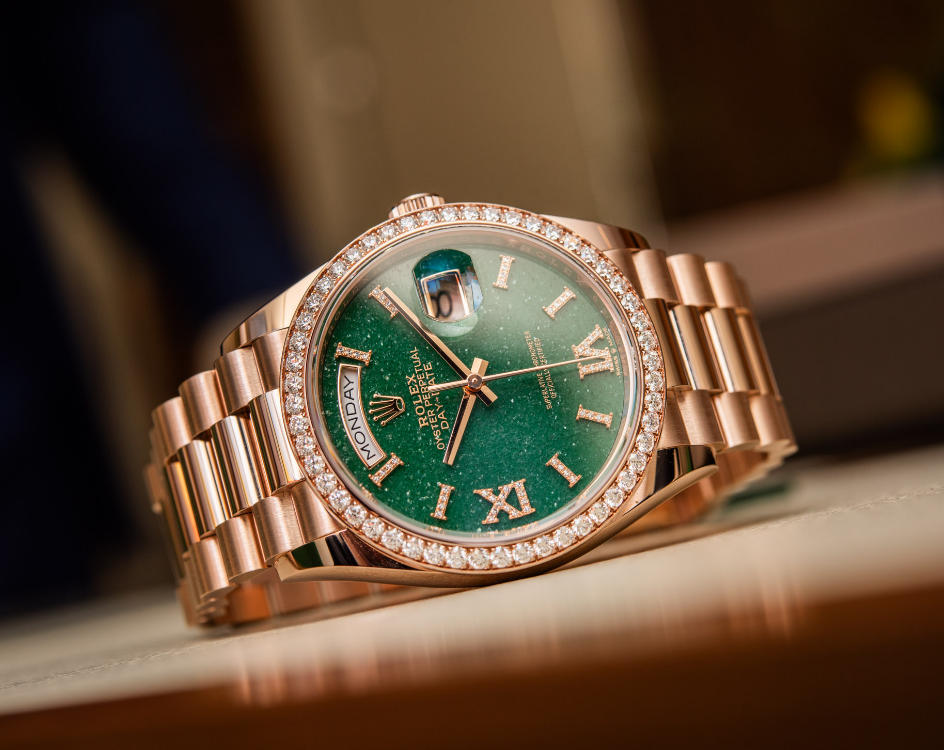
The Rolex Day-Date 36 has always been recognised for its precious metal case, distinctive President bracelet and the combination of day and date displays. Its overall design has changed relatively little compared with some other Rolex collections, but the dial has provided room for more unusual interpretations. The green aventurine and turquoise versions are particularly interesting because they change the appearance of the watch without changing the proportions that make the Day-Date so recognisable.
These two stone dials were part of Rolex’s 2023 Day-Date 36 releases. Green aventurine brought a finely crystallised green surface to the Everose gold model, while turquoise introduced a much brighter blue with natural variations in colour and pattern. They are not simply alternative dial colours. The materials have different visual characteristics, and those differences become more apparent when the watches are viewed in natural light.
For readers interested in replica watches UK, the distinction is worth examining closely. A convincing stone dial depends on more than matching the general colour. Its surface, natural pattern, applied markers and calendar openings all contribute to the appearance of the finished watch. These are also some of the most difficult details to reproduce accurately.
Two stone dials with very different personalities
The green aventurine Day-Date 36, reference 128235, combines an 18ct Everose gold case with a fluted bezel and matching President bracelet. Its dial is cut from natural aventurine, a material known for its finely crystallised surface. Rather than producing the uniform reflection of a conventional sunburst dial, the stone catches light through its small crystalline details. The green can look relatively dark in subdued conditions before revealing more of its texture under stronger light.
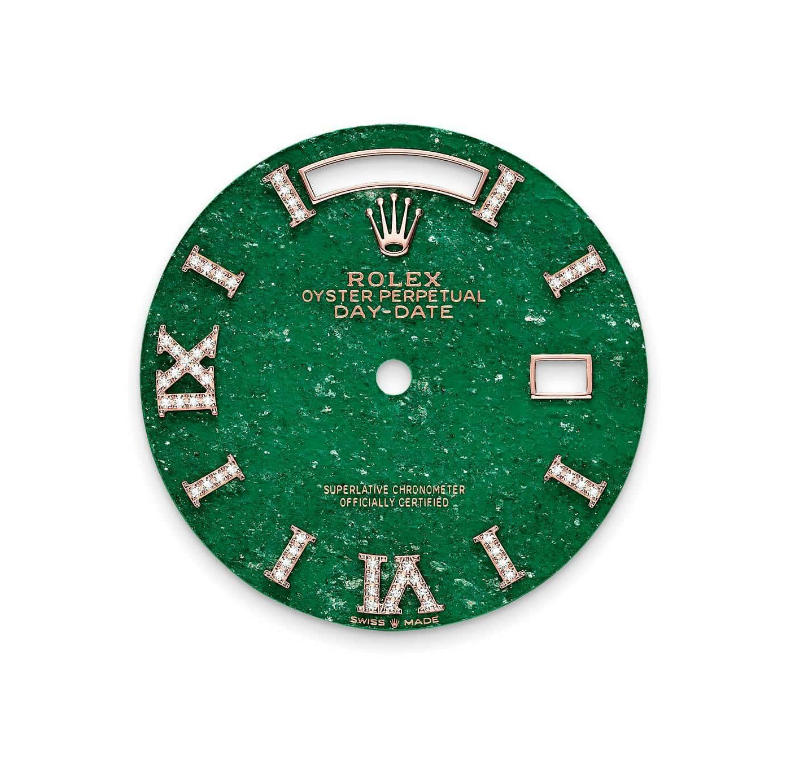
Rolex uses 18ct gold hour markers set with 32 diamonds, together with diamond-set Roman numerals at six and nine o’clock. These details are important to the layout. The Day-Date already has a large day aperture at twelve and a date window at three, leaving limited space for additional decoration on a 36mm dial. Using a combination of diamond markers and two Roman numerals gives the face a more balanced appearance without covering the stone completely.
There is also a difference in the finishing of the dial text. On the green aventurine version, the printing has a warm tone that works with the Everose gold case. The hands are polished rather than filled with luminous material, keeping the overall appearance relatively formal. This is a deliberate design choice: the watch relies on the contrast between the gold details and the natural stone rather than on bright luminous markings.
The turquoise versions have a different character. Their blue surface is more immediately noticeable, but the natural matrix and irregular markings are just as important as the colour itself. The printing is black, providing a stronger contrast against the lighter stone, while the applied gold markers and diamond settings follow the precious metal of the individual case configuration.
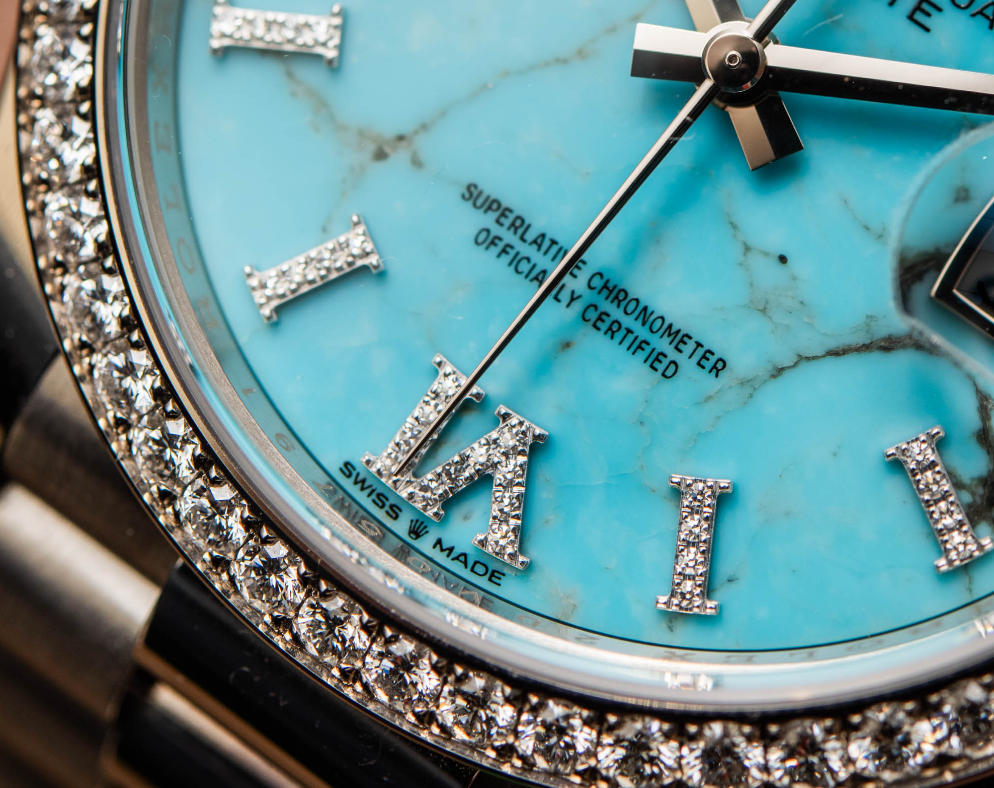
Rolex’s 2023 catalogue included turquoise Day-Date 36 references in yellow gold, white gold, Everose gold and platinum. These included fluted and diamond-set bezel configurations. The green aventurine selection was more restricted, centred on Everose gold versions with either a fluted or diamond-set bezel. These are historical catalogue configurations and should not all be assumed to remain available in the UK in 2026.
The difference between the two materials is more important than it might first appear. Aventurine has a fine crystalline appearance, whereas turquoise is recognised for its colour and natural striations. A photograph can make either surface look flatter than it really is, particularly when lighting and image processing exaggerate the colour. The texture is part of the design, not a minor detail that can be replaced by applying a similar shade of paint.
The size of the watch makes this particularly noticeable. At 36mm, the Day-Date has a compact dial carrying two prominent calendar displays, polished hands and diamond-set markers. There is relatively little unused space. The stone therefore needs to work with the existing layout rather than simply provide a decorative background. This is one reason the Rolex Day-Date 36 green aventurine dial and Rolex Day-Date 36 turquoise dial have such distinctive appearances despite sharing the same basic case design.
Producing these dials also involves more than cutting a piece of attractive stone to size. Openings are required for the hands and calendar displays, while additional fixing points are needed to secure the applied markers. Each cut introduces a potential weak point in a relatively thin and delicate material. The stone must retain its appearance while being finished accurately enough to accommodate the watch’s other components.
One interesting consequence is that the diamond-set markers cover a substantial part of the stone surface. This differs from some vintage Rolex stone dials, where the absence of prominent hour markers allowed the natural material to remain the main focus. On the modern Day-Date 36, Rolex has chosen a more decorative arrangement, combining the irregularity of natural stone with the precision of precious metal settings.
What matters when comparing the genuine watch with a replica
The dial is only one part of the Day-Date 36. The current green aventurine reference 128235 uses Rolex Calibre 3255, an automatic movement with approximately 70 hours of power reserve. It provides the central time display together with instantaneous day and date indications, including rapid-setting functions. The movement also features a blue Parachrom hairspring and Paraflex shock absorbers.
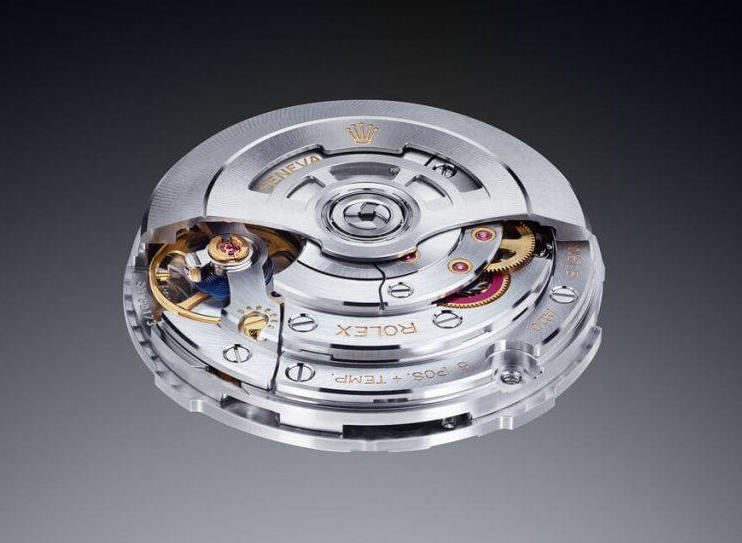
These functions are central to the model’s identity. The day display at twelve is one of the defining features of the Day-Date, while the date window at three is enlarged by the Cyclops lens on the sapphire crystal. The 36mm Oyster case has a screw-down crown and caseback and is rated to 100 metres of water resistance. These details remain important when comparing different references, even when the dial material changes.
The President bracelet deserves equal attention. Its rounded three-piece links have been associated with the Day-Date since the collection’s introduction in 1956. On the stone dial versions, the bracelet is made from the same precious metal as the case and finished with a concealed folding Crownclasp. Its shape, articulation and surface finishing contribute considerably to the way the watch sits on the wrist.
For a Rolex Day-Date 36 replica watch, the natural stone dial is arguably the most demanding external detail. A printed green pattern may reproduce the general impression of aventurine, but it does not necessarily have the fine crystalline appearance of the genuine material. The same applies to turquoise. A blue dial with dark markings can look similar in a product photograph without reproducing the depth and irregularity of natural stone.
The diamond settings create another challenge. Their size, spacing and alignment need to work with the day and date windows. The Roman numerals at six and nine are particularly noticeable because they help balance the calendar displays. If the markers are too large, poorly aligned or fitted at the wrong height, the dial can quickly lose the proportions of the original.
Case material and bracelet construction should also be considered separately. The warm appearance of Everose gold is different from ordinary rose gold, while yellow gold, white gold and platinum each produce their own visual effect. A similar surface colour does not establish that the material or finishing is the same. Weight, polished surfaces, lug proportions and bracelet articulation all influence the finished watch.
The movement is another area where product descriptions need to be treated carefully. The genuine reference uses Calibre 3255, but a replica should not be assumed to contain the same movement simply because a seller uses that calibre number. An alternative movement may provide automatic timekeeping and calendar functions while having a different construction and operating characteristics.
Terms such as AAA, 1:1 and super clone are not recognised technical grades. They do not establish whether a dial uses natural stone, whether the diamond settings are correctly constructed or whether the movement corresponds to the original. A more useful comparison looks at the actual materials, dimensions, dial layout and mechanical functions.
Readers interested in other models can find further coverage in our Rolex replica watches collection. The Day-Date, Datejust, Submariner and GMT-Master II each have different construction details, so the points that matter when comparing one model will not necessarily apply to another.
For UK readers, the current green aventurine Ref.128235 is still listed on Rolex’s British website, while the turquoise configurations are best understood in the context of the earlier catalogue releases. This distinction matters when researching reference numbers, historical specifications and availability. Older prices and configurations should not be presented as current UK retail information without checking the latest official listing.
The appeal of these Day-Date 36 models comes from the contrast between a familiar Rolex design and materials that are naturally inconsistent. The case, calendar displays and President bracelet remain recognisable, but the stone surface gives each version a different appearance. That is also what makes them more interesting to compare than ordinary coloured-dial models. The real differences are found in the texture of the stone, the precision of the diamond settings and the way the complete watch is constructed, rather than in the colour alone.